Malden, Massachusetts was first settled in 1640. It was incorporated as a town in 1649 and as a city in 1881. Prior to 1649, it was part of Charlestown called Mystic Side.
Groton, Middlesex County, Massachusetts was settled and incorporated in 1655
American colonists continued to use British monetary units, namely the pound, shilling and pence for which £1 (orli) equalled 20s and 1s equalled 12d. In 1792 the dollar was established as the basic unit of currency.
Elizabeth Fones (1610) was a Puritan woman in New England. She married her cousin, Henry Winthrop, son of John Winthrop. After he died, she married Robert Feake and lived in Watertown and Greenwich, Massachusetts. Robert apparently suffered from mental illness and abandoned his family. She then lived with William Hallett in Long Island.
In 1688, during theGlorious Revolution, the Protestant king and queen,William and Mary, took the English throne from Catholic King James II. The bloodless revolution profoundly impacted the American colonies.
Mary Davis Lewis Pratt was born on January 31, 1661/62 in Groton, Middlesex County, Massachusetts. Her parents were Samuel Davis and Mary Waters.
She married her first husband, Isaac Lewis of Boston on March 25, 1680. Isaac was born about 1657. His parents were John Lewis and Mary Browne.
Mary and Isaac's children included:
Mary Lewis Sargent (1680/81, married William Sargent), Isaac Lewis (1683),
Joseph Lewis (1685),
John Lewis (1687/88),
Elizabeth Lewis (1688/89) and
Abraham Lewis (1691).
Isaac Lewis died on April 6, 1691 when he was 34 years old in Malden, Massachusetts. He was buried at Bell Rock Cemetery there.
HERE LYES ye BODY
OF ISAAC—LEWIS
AGED—34—
YEARS
WHO DEPARTED THIS LIFE-APRIL-YE-6TH
1691
Mary married her second husband, Thomas Pratt, in 1691. Thomas was born in 1669 in Malden. His father was John Pratt, a mariner from Malden.
In 1695, Thomas purchased the Way-Ireland farm.
Mary and Thomas' children included:
Elizabeth Pratt Sargent Tufts George (1692/93, married Samuel Sargent in 1714, John Tufts in 1723, and Nicholas George in 1727),
Ann Pratt (1694), Sarah Pratt Blanchard (1697, married Joshua Blanchard), Captain Thomas Pratt (1699), and
Samuel Pratt (1703/04, married Rebecca Brooks).
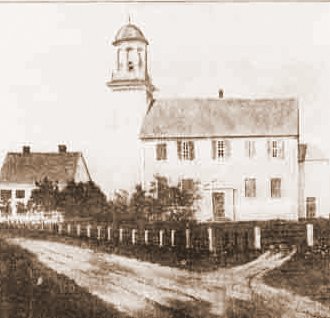
Thomas contributed to building the meeting house in Malden in 1704. In 1709-10 he signed a protest against building one in Rumney Marsh.
First Church of Rumney Marsh
Thomas died in Chelsea on June 25, 1732. He is buried in Edgewood Cemetery in Malden.
When her husband died she had no property because married women could not own property. According to her husband’s will, Mary would leave the farm if she remarried and would receive an annuity of twelve pounds, but while she was a widow, the house and household items were hers. She also received
two cows,
two geese,
two turkeys,
six hens,
a pig
one hundred pounds of beef,
one hundred twenty pounds of pork,
ten bushels of Indian corn,
two bushels of rye,
two bushels of malt
six bushles of apples,
two barrels of cider,
firewood cut ready for burning .
She received an annuity of 10£ and was to be taken to meeting and home again as often as she desired.
Groton, Middlesex County, Massachusetts was settled and incorporated in 1655. During King Philip's War, indigenous warriors burned all but four of Groton's garrisons. Survivors fled, but returned two years later to rebuild the town. Groton was again threatened during Queen Anne's War.
Cattle were vital to a household and an important legacy.
Unweaned cattle are calves.
Female cattle are heifers and cows (had a calf).
Male cattle are steers (castrated) and bulls.
Oxen are trained draft animals and are often castrated adult male cattle.
Old Style Calendar
Before 1752 the year began on Lady Day, March 25th,. Dates between January 1st and March 24th were at the end of the year. Old Style (O.S.) and New Style (N.S.) are used to indicate whether the year has been adjusted. Often both dates are used.
During the 17th and 18th centuries an adult unmarried woman was considered to have the legal status of feme sole, while a married woman had the status of feme covert. A feme sole could own property and sign contracts. A feme covert was not recognized as having legal rights and obligations distinct from those of her husband and could not own any property. When a woman became a widow she became a feme sole again.
The use of the term ye to mean the derives from Early Modern English, in which the was written "þe," employing the Old English letter thorn: "þ."
Ye is also the plural of thou.
Women played an essential role in American society as mothers and homemakers.
The New England Meetinghouse was the only municipal building in a town. Both worship and civil meetings were held there. It was customary for men and women to sit separately and the town chose a committee once a year to assign seats according to what was paid, age, and dignity.
Indian Corn (or flint corn) is the type of maize that Native Americans taught colonists to cultivate. The kernels come in a range of colors and are less prone to spoiling.